




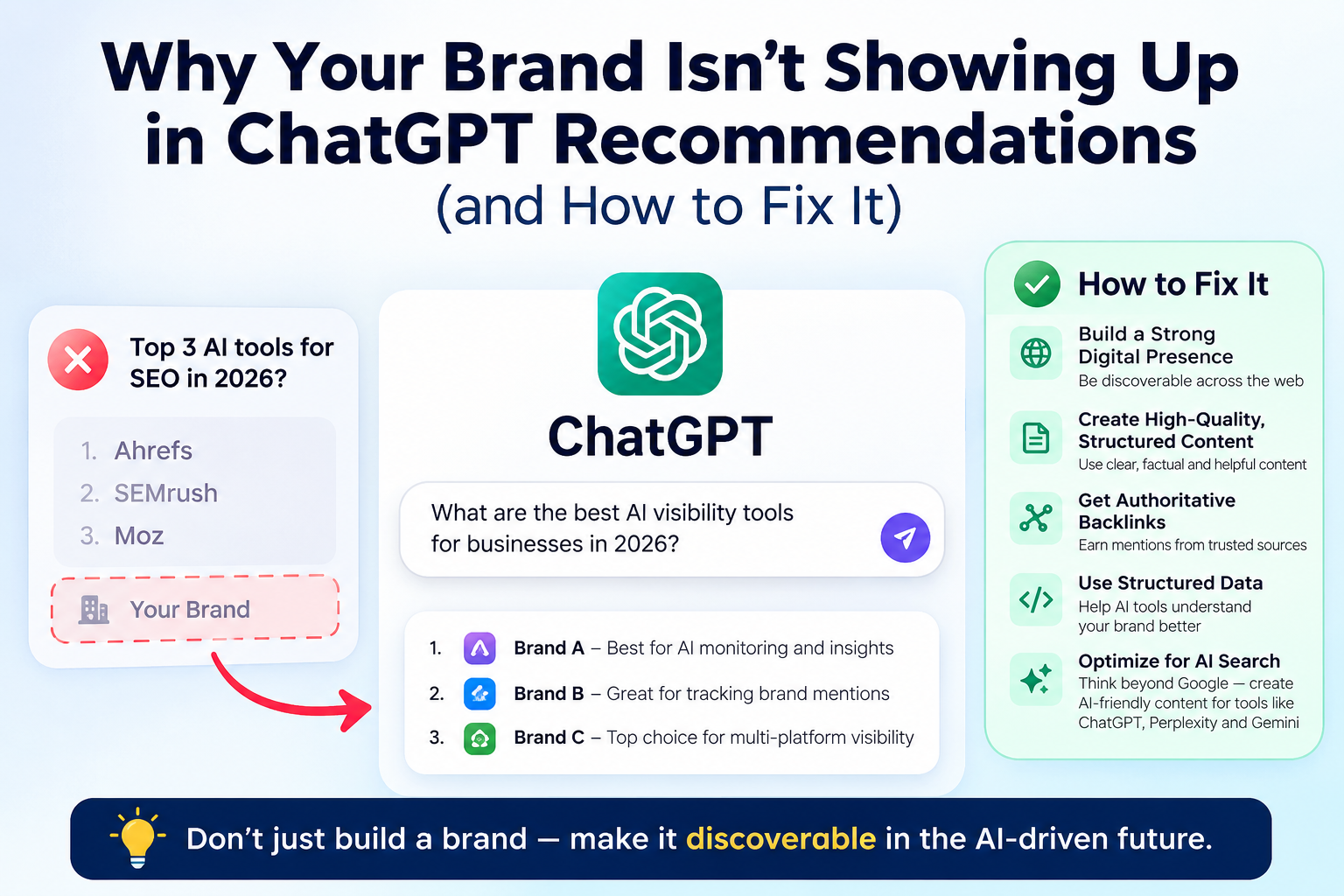
If you’ve typed your own brand name into ChatGPT lately and watched it recommend three competitors instead, you’re not imagining a glitch. You’re seeing the new front line of visibility, and most brands are losing it without knowing they’re even in the fight. This is exactly the blind spot that LLM brand visibility tools like Branviz were built to expose.
For the last twenty years, marketing teams optimized for one thing: showing up on page one of Google. That skill still matters, but it’s no longer the whole game. A growing share of buying research now happens inside conversational AI: someone asks ChatGPT, Gemini, or Perplexity “what’s the best CRM for a 50-person sales team” or “which project management tool works best for agencies,” and the model hands back a shortlist of three to five names. If your brand isn’t on that shortlist, you don’t lose a ranking position, you lose the conversation entirely.
Why do LLMs recommend some brands and ignore others?
Large language models don’t rank pages the way a search engine does. They generate an answer based on patterns learned from training data and, increasingly, from real-time retrieval of web content. That means a model’s opinion of your brand is shaped by how often, how clearly, and how consistently your brand is described across the web, not by how well your homepage is optimized for a keyword.
In practice, three things drive whether a model recommends you:
- Frequency of mention. How often does your brand name appear alongside the category you compete in, across independent sources?
- Clarity of association. Is it obvious, from the text itself, what you do and who you’re for? Vague positioning confuses extraction models the same way it confuses human readers.
- Corroboration. Do multiple sources (review sites, comparison articles, forums, press coverage) say similar things about you? Models weigh agreement across sources more heavily than a single confident claim on your own site.
This is why a brand with strong SEO can still be invisible in AI answers. Ranking on Google rewards on-page optimization and backlinks. Being recommended by an LLM rewards being consistently and clearly described across the open web, in language that matches how people actually ask questions. An LLM brand visibility tool such as Branviz scores exactly these three factors, frequency, clarity, and corroboration, so you can see which one is actually holding your brand back instead of guessing.
How is this different from ranking in Google?
Google surfaces a page. An LLM synthesizes an answer and then decides whether to name you inside it. That’s a much higher bar. You can rank #3 for “best accounting software for freelancers” and still get zero mentions in ChatGPT’s answer to the exact same question, because the model isn’t reading your landing page top to bottom, it’s pulling fragments from wherever your brand is discussed and stitching together a recommendation.
That also means the content that helps you here isn’t always the content that helps you in traditional SEO. A comparison article on a third-party blog that plainly states “Brand X is a good fit for small teams because of Y” is often more valuable for AI visibility than another blog post on your own domain, because it’s an independent, corroborating source the model can pull from. Enterprise teams increasingly use an LLM brand visibility tool like Branviz to confirm which third-party sources are actually moving the needle before investing more budget in outreach.
What can you audit today to see where you stand?
Before fixing anything, you need a baseline. Three checks will tell you most of what you need to know:
- Ask the models directly. Query ChatGPT, Gemini, and Perplexity with the exact questions your buyers would ask (“best [category] for [use case]”), across a handful of realistic prompts. Note whether you appear, where you rank in the list, and who appears instead.
- Check your technical readiness. Many sites unintentionally block or bury the content that helps AI crawlers understand them, through heavy client-side rendering, thin or duplicate metadata, or a lack of structured data. If a crawler can’t parse your page cleanly, it can’t inform a model’s answer.
- Look at your third-party footprint. Search for your brand name alongside your category on review sites, comparison blogs, and forums. If most of what exists is your own marketing copy, you have a corroboration gap, not just a content gap.
Purpose-built LLM brand visibility tool, Branviz among them, automate this by running your brand against dozens of realistic prompts across multiple models, scoring your share of voice against named competitors, and flagging the specific technical signals a site is missing for AI-crawler inclusion. That turns “I think we’re not showing up” into an actual number you can track month over month, the same way you’d track keyword rankings, and Branviz’s free audit is a fast way to get that first baseline number.
What’s the fix once you find the gaps?
Once you know where the gaps are, the fixes tend to fall into three buckets:
- Fix the technical foundation. Make sure your key pages are crawlable without relying on JavaScript rendering, add clear schema markup, and write page content that states plainly what you do and who it’s for, in the first few sentences, not buried after three paragraphs of brand voice.
- Build corroborating mentions. Pitch guest posts, comparison pieces, and expert quotes to third-party publications in your niche. The goal isn’t backlinks in the SEO sense, it’s independent sources describing your brand in consistent, factual language that a model can cross-reference.
- Answer the actual questions buyers ask. Structure content around the specific phrasing people use when they talk to AI assistants, not just the keywords they’d type into Google. FAQ sections, direct comparison tables, and clearly labeled use-case breakdowns all perform better here than long narrative copy.
None of this replaces traditional SEO, it runs alongside it. But treating AI visibility as a separate, measurable channel, rather than an afterthought of your existing SEO strategy, is quickly becoming the difference between brands that get recommended and brands that quietly disappear from the conversation.
FAQ
Does ranking well on Google guarantee I’ll be recommended by ChatGPT? No. Google rewards page-level optimization; LLMs synthesize answers from mentions across the whole web, including sources you don’t control.
How often should I check my AI visibility? Monthly is reasonable for most brands, since model outputs and training data can shift between updates. Enterprise teams in competitive categories often check more frequently.
Do I need a dedicated tool to track this, or can I just ask the models myself? Manually querying models works for a spot check, but it doesn’t scale across the volume of prompts, models, and competitors needed for a reliable trend line. A dedicated LLM brand visibility tool like Branviz automates that tracking and benchmarks you against named competitors over time.
Is this the same thing as “AEO” or “GEO”? Yes, these are largely overlapping terms (Answer Engine Optimization and Generative Engine Optimization) both describing the practice of optimizing for visibility inside AI-generated answers rather than traditional search results.