






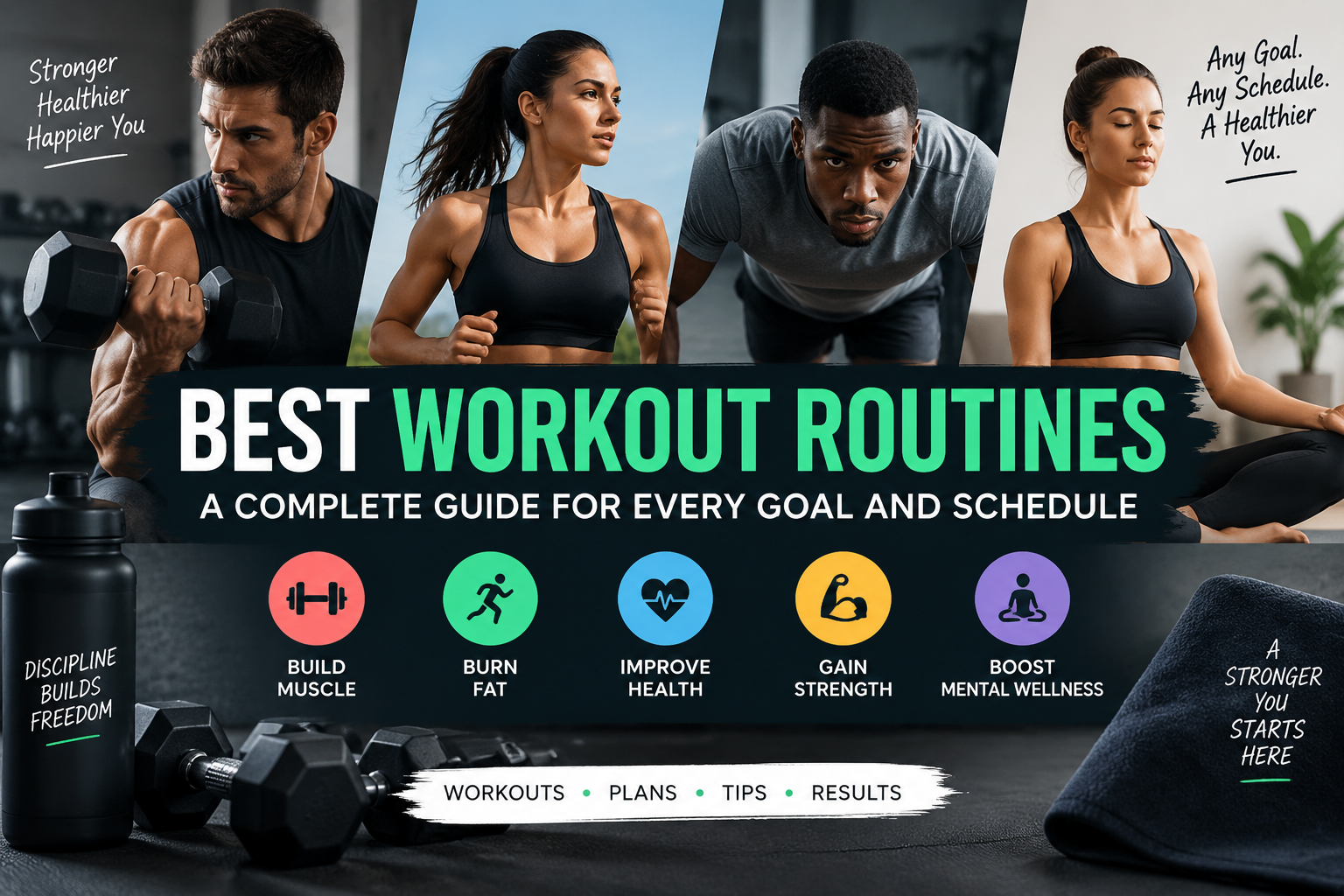


There’s no shortage of workout advice online, and most of it contradicts itself. One influencer swears by five days a week of heavy lifting, another insists cardio is all you need, and somewhere in between you’re just trying to figure out what actually works for your life. The truth is simpler than the noise suggests: the best workout routine is the one that matches your specific goal, fits your schedule, and you’ll actually stick with consistently.
Here’s a breakdown of the best workout routines for the most common goals, built around principles that hold up regardless of which trend comes and goes.
For General Fitness: Push/Pull/Legs (3–4 Days a Week)
If your goal is simply to get stronger, look better, and feel more capable in daily life, a push/pull/legs (PPL) split is one of the most efficient and sustainable routines available. The structure is simple: one day focuses on pushing movements (chest, shoulders, triceps — think bench press and overhead press), one day focuses on pulling movements (back and biceps — rows, pull-ups), and one day focuses on legs (squats, deadlifts, lunges).
Rotating through these three sessions three to four times a week hits every major muscle group with enough frequency to build real strength, while leaving built-in recovery days for cardio, mobility work, or simply resting. The compound lifts at the core of this split — squats, deadlifts, bench press, rows — are efficient because they train multiple muscle groups simultaneously, which means better results in less total gym time compared to routines built around isolated exercises.
For Fat Loss: Strength Training + Strategic Cardio
A common mistake people make when trying to lose fat is defaulting to hours of cardio while ignoring strength training entirely. In reality, the most effective approach combines both. Two to three strength training sessions per week help preserve (or even build) muscle mass while you’re in a calorie deficit, which matters enormously for how your body looks and functions once the weight comes off.
Layer in two cardio sessions weekly — either 30 to 45 minutes of moderate-intensity cardio like brisk walking, cycling, or swimming, or shorter 15 to 20 minute high-intensity interval training (HIIT) sessions if you’re short on time. It’s worth being honest about priorities here: diet plays a larger role in fat loss than exercise type. No workout routine, however well designed, will out-train a calorie surplus. Think of training as the tool that determines what your body looks like at your eventual weight, not the primary driver of weight loss itself.
For Beginners: Full-Body Strength Training (3x/Week)
If you’re new to structured exercise, don’t jump straight into a complex split routine. Full-body strength training three times a week — following a simple, well-established program like Starting Strength or StrongLifts 5×5 — builds a genuine foundation of strength and movement competency before you add complexity.
These programs typically center on a small number of compound lifts (squat, deadlift, bench press, overhead press, row) performed across all three weekly sessions, with weight increasing gradually as you get stronger. The simplicity is the point: beginners see rapid strength gains on almost any reasonable program, so there’s no need to overcomplicate things early on. Save split routines and more advanced programming for once you’ve built a year or so of consistent training experience.
For Busy Schedules: 20-Minute Full-Body Circuits
Not everyone has an hour to spend at the gym four or five days a week, and that’s genuinely fine. Twenty-minute full-body circuits — using kettlebells, dumbbells, or just bodyweight movements — can hit every major muscle group without requiring a long session. A sample circuit might rotate through squats, push-ups, rows, lunges, and planks, performed with minimal rest between exercises.
Doing this four times a week delivers real strength and conditioning benefits, and the shorter time commitment often makes it far easier to stay consistent than a routine that requires 90 minutes at the gym. Consistency, more than intensity or duration, is usually the single biggest predictor of long-term results.
For General Health: The Minimum Effective Dose
If your goal isn’t aesthetics or athletic performance but simply staying healthy long-term, the bar is lower than most fitness content suggests. Public health guidelines consistently point to 150 minutes of moderate cardio per week — spread across walking, cycling, swimming, or similar activities — combined with two full-body strength sessions.
This baseline covers the majority of health benefits associated with exercise: cardiovascular health, bone density, metabolic function, and mental health improvements. It’s a genuinely achievable target for almost anyone, and it’s worth remembering that “the best routine” doesn’t need to be complicated or exhausting to be effective.
Putting It Together: Choosing Your Routine
Want overall strength and physique improvement, have 3–4 days available: Push/pull/legs split. Focused specifically on losing fat: Strength training 2–3x/week plus 2 cardio sessions, with diet as the primary lever. Brand new to training: Full-body strength 3x/week on a simple program. Short on time but want real results: 20-minute full-body circuits, 4x/week. Just want to be healthy, not chasing a specific physique: 150 minutes of cardio plus 2 strength sessions weekly.
A Few Practical Notes
Progressive overload — gradually increasing weight, reps, or difficulty over time — is the underlying principle that makes any of these routines effective long-term. Without it, your body adapts and progress stalls, regardless of which program you’re following.
Recovery matters as much as the workouts themselves. Muscles grow and adapt during rest, not during the workout, so adequate sleep and at least one or two full rest days per week aren’t optional extras — they’re part of the program.
Finally, if you’re new to exercise, have any existing injuries, or have underlying health conditions, it’s worth checking in with a doctor or physical therapist before starting an intense new routine. This article is general information, not personalized medical or fitness advice.
The Bottom Line
There’s no single “best” workout routine — there’s the best routine for your specific goal, schedule, and experience level. The programs above are all built on well-established training principles, which means the real variable isn’t which one you pick, but whether you can stay consistent with it for months, not weeks.